GBP/USD at 1.3288: Warsh hawkish repricing narrows BoE-Fed spread
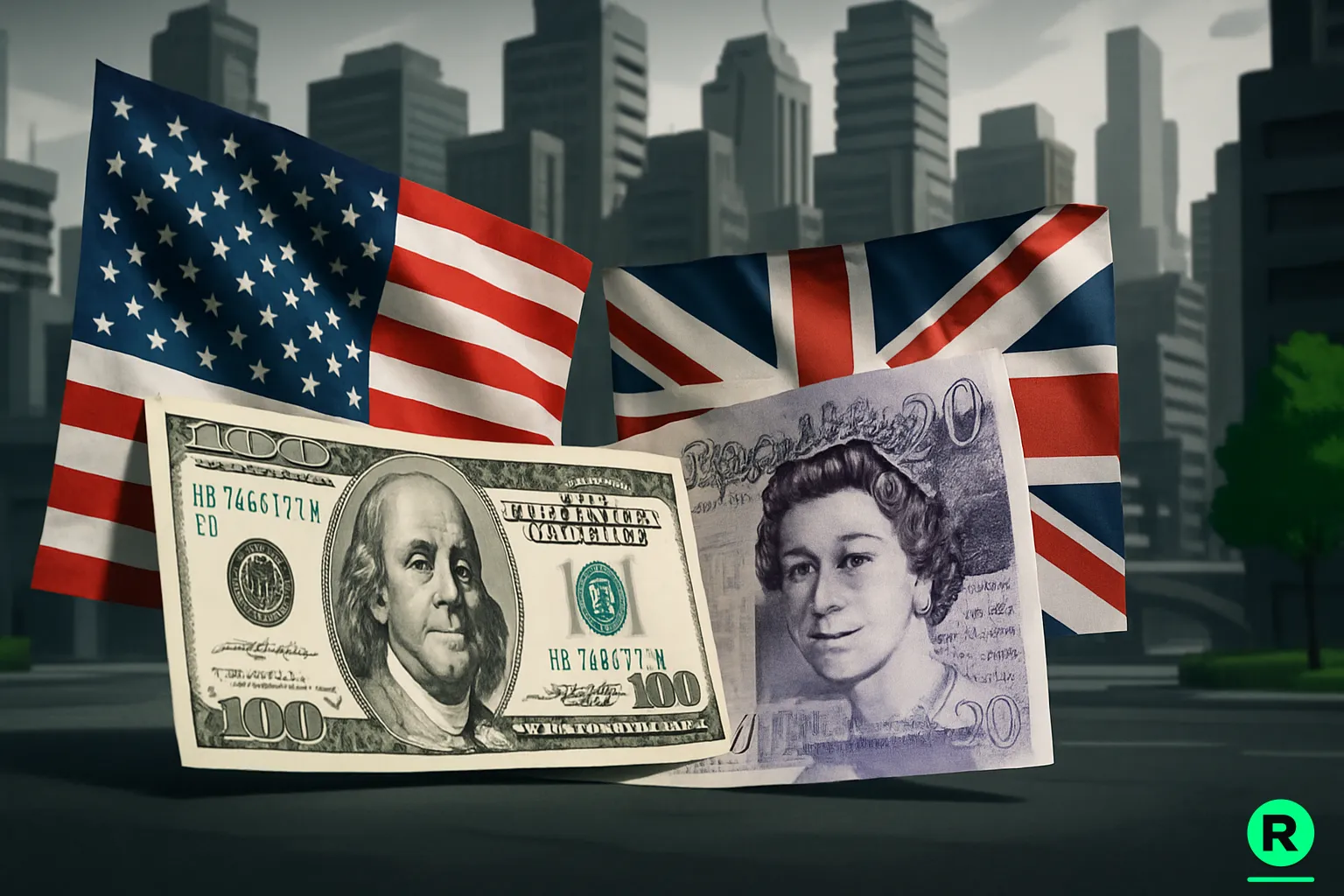
GBP/USD fell 0.06% to 1.32876 as Fed Chair Warsh signaled higher-for-longer rates on June 18, widening the US-Japan rate differential to 340bp while sterling holds rangebound above 1.3285. Live chart, BoE divergence, cross-asset carry unwin
TL;DR
- Warsh hawkish June 18 FOMCThe Federal Open Market Committee - the Fed's rate-setting body., dot plot two 2026 hikes, narrows BoE-Fed spread
- DXYThe US Dollar Index — trade-weighted USD against EUR, JPY, GBP, CAD, SEK, CHF. +0.91% to 28.185 three-month high drags cable lower vs broad dollar surge
- 1.3300 technical floor in focus; break opens path to 1.3200 retest
- June 25 CPI catalyst will test Fed's 3.8% year-end inflationThe rate at which prices rise across an economy. forecast
Key levels
- resistance1.3508Recent swing high; break signals recovery toward 1.3400-1.3550
- support1.3300Technical floor; firm break resumes 1.3657 top decline to 1.3200
- pivot1.3288Current mid-range; BoE-Fed differential anchor point
Cross-asset confirmation
- $DX-Y.NYBThree-month high at 28.185 on hawkish Fed repricing+0.91%
- $USDJPY158 weakest yen since July 2024; 340bp rate gap fuels carryIncome earned from holding a position over time. unwind+2.1% ytd
- $EURGBPEuro climbs vs sterling; euro outperformance narrows BoE-Fed spread effect+0.07%
- $FXBSterling ETFExchange-Traded Fund - a basket of securities trading like a single stock. weakness confirms cable downside pressure-1.03%
Full brief
GBP/USD traded flat on June 17, closing near 1.32876 after a narrow intraday range of 1.3285 to 1.33053. The pair has consolidated tightly over the past five sessions, caught between the hawkish Fed repricing and persistent BoE caution. Cable initially held above 1.3300 in early European trading but faced headwinds as the US dollar index surged 0.91% to 28.185, its highest level in three months, following Chair Kevin Warsh's June 18 FOMCThe Federal Open Market Committee - the Fed's rate-setting body. statement signaling two rate hikes by year-end 2026.
The core driver is the widening BoE-Fed rate differential. Warsh's debut press conference emphasized the Fed's inflationThe rate at which prices rise across an economy. mandate, stating the central bank sees no reason to revisit the 2% target until inflation is delivered. The dot plot now projects an end-of-year 2026 inflation reading of 3.8%, implying the Fed remains committed to hawkish positioning while the BoE has signaled caution on further tightening. This hawkish-dovish split compresses sterling relative to the dollar and explains Cable's downside bias despite UK gilt yields holding steady. The Fed's 340bp rate advantage over Japan has already triggered carryIncome earned from holding a position over time.-trade unwind in crypto markets (Bitcoin and Ethereum volatility spiked), and sterling weakness is a natural spillover from that broader dollar rally.
Cross-asset confirmation is decisive. The dollar index (DXY) climbed 0.91% to 28.185, a three-month peak, while USDJPY surged to 158, the yen's weakest level since July 2024. Notably, EUR/USD managed only a 0.01% gain to 1.15034, meaning the dollar's strength is broad-based rather than euro-specific. EUR/GBP rose 0.07% to 0.86575, a direct read on sterling underperformance. FXB (a sterling ETFExchange-Traded Fund - a basket of securities trading like a single stock. proxy) fell 1.03%, confirming weakness in the pound complex. This synchronized dollar strength across all cross-rates underscores the hawkish Fed shock and its systematic headwind for all non-USD currencies.
Key technical levels in Cable show 1.3300 as a near-term floor; ActionForex's technical bias flagged downside risk as long as the 1.3508 resistance holds. A decisive break below 1.3300 would resume the decline from 1.3657 toward untested support. On the upside, cable faces 1.3508 as the immediate ceiling. No clear support is pinned below 1.3285 in the immediate horizon, but the five-day lows cluster near 1.3270.
Positioning data remain opaque, but the unwind in carryIncome earned from holding a position over time. trades (evident in crypto volatility and EM currency pressure) suggests positioning reset is underway. The immediate catalyst is the June 25 CPI print, which will either validate the Fed's hawkish pivot or force a moderation. If inflationThe rate at which prices rise across an economy. data surprise lower, Warsh's hawkish bias could soften and allow cable to recover toward 1.3400. Conversely, sticky inflation locks in the two-hike expectation and pushes cable toward 1.3200.
Central bank watch · BOE / FED
Fed Chair Warsh signaled higher-for-longer on June 18, with the dot plot projecting two rate hikes by year-end 2026 and a 3.8% inflationThe rate at which prices rise across an economy. reading. The BoE remains on hold and cautious, creating a policy divergence that compresses sterling. Watch for BoE forward guidanceCompany-issued forecasts of future financial performance. in early July to test whether the bank will defend cable against Fed-driven dollar strength.
Catalysts to watch
- highCPI June 2026 printJune 25, 2026
- highBoE Monetary Policy Committee decisionTBD early July
- mediumUS June nonfarm payroll & jobless claimsEarly July
Tracking the rate-differential trade — Fed-ECB, Fed-BoJ, Fed-BoE policy gaps and the FX moves that price each divergence shift.
GBP/USD ('cable') is the world's third-largest FX pair. Direction is set by the BoE-Fed 2Y yield spread, UK CPI surprises and gilt market stress. The 1.20-1.30 range is the modern cycle anchor. Watch London open (07:00 UTC) for the biggest moves.