What it means
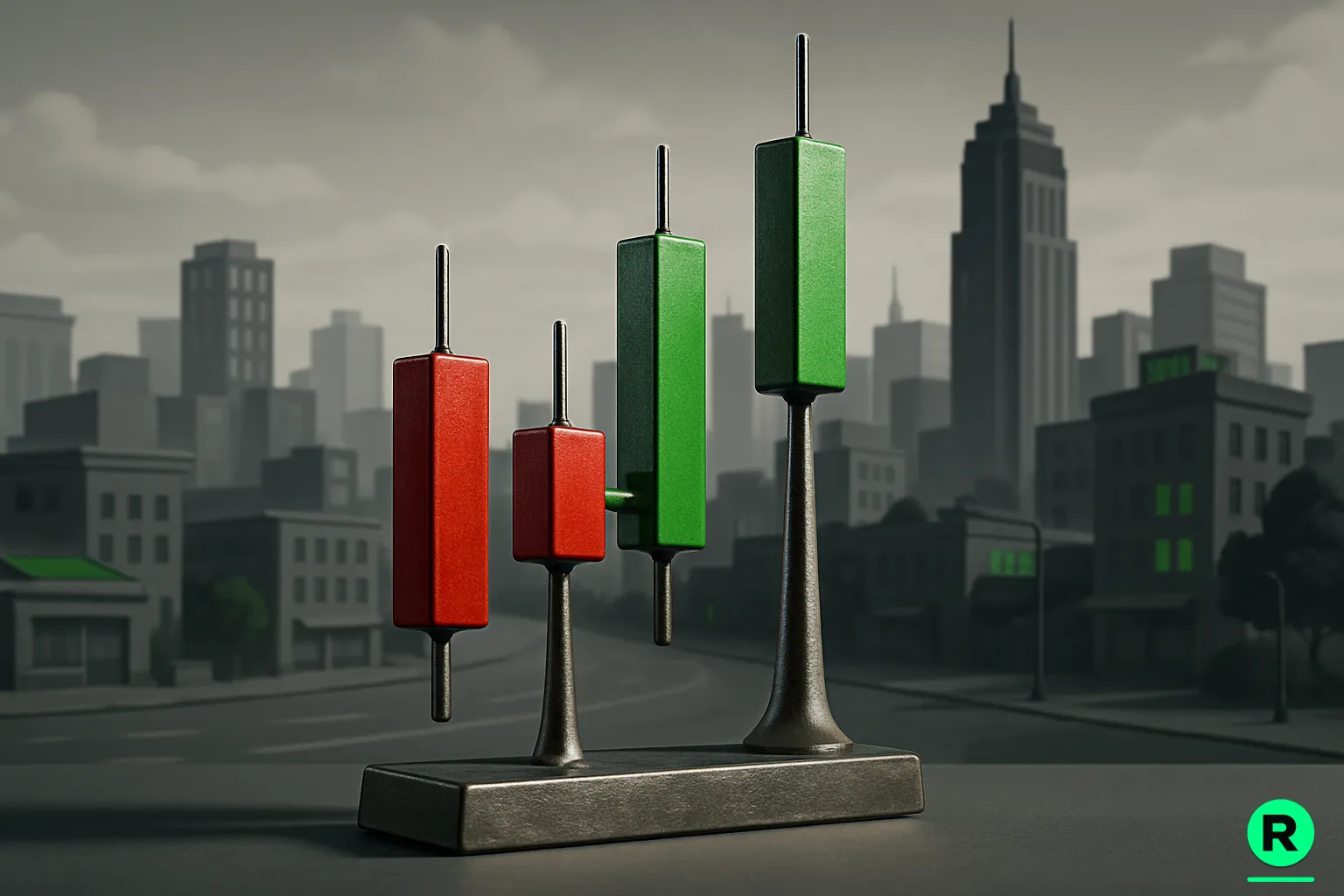
Morning star (bullish reversal at bottoms): (1) Large red candle confirming downtrend, (2) small-body candle (any color, often doji) gapping lower or just below, (3) large green candle gapping higher or opening within the small body, closing well into the first red candle's body. Evening star (bearish reversal at tops): the inverse — large green, small body up high, large red closing into the first green body. Three-candle structure provides multiple confirmation points.
Why it matters
Star patterns are among the highest-reliability reversal signals because they encode a full sentiment-shift narrative: first candle confirms prior trend, second shows indecision/pause, third shows new direction taking control. Bulkowski reports ~71% morning star and ~72% evening star reliability — higher than most two-candle patterns. Star patterns are particularly common at major trend reversals.
How to use it
Pattern complete = third candle closes ≥50% into the first candle's body. Confirmation = next candle continues in the reversal direction. Trade on the close of the third candle (early entry) or after confirmation (safer entry). Stop beyond the star's extreme (low for morning, high for evening). Target = recent trend leg projected from breakout.
BTC October 2023: (1) Large red candle Oct 13 ($28,400→$26,700), (2) small doji-like candle Oct 14 ($26,700-$26,900 tight range), (3) large green candle Oct 15 opening $26,800, closing $28,800 — well into the first red body. Confirmed morning star at the bottom of the $32K→$26K correction; rally to $44K over next 6 weeks.
Strict pattern definition and tolerances
Three candles required. First candle: closing range of ≥1 standard deviation against the recent 20-day range. Second (the 'star'): small body, ideally gapping away from the first (in the direction of the prior trend). Third: opposite color of first, closing ≥50% into the first candle's body. Volume signature: heavy on first, light on second, heavy on third — reflecting the sentiment shift.
Variants — abandoned baby and star with doji
Two stronger variants of the star pattern: (1) Star with doji = second candle is specifically a doji (very small body, long wicks) — highest reliability (~75%+ per Bulkowski). (2) Abandoned baby = second candle is a doji AND fully gaps away from both the first and third candle, leaving an island. Rare but ~80%+ reliability when correctly identified. Both variants outperform the standard 'small-body second candle' star.
Frequently asked
Does the gap between candles matter?
Larger gaps strengthen the signal but aren't required. A 'star' that gaps materially away from the first candle (typical in stocks on news) signals stronger reversal flow than one with no gap. In 24-hour markets (crypto, FX) gaps are rare; absence of gap doesn't invalidate the pattern.
Can the third candle exceed the first candle's open?
Yes — and that's actually the strongest version. A third candle that fully retraces the first candle's range is the highest-conviction reversal signal. Minimum requirement is ≥50% retracement; full retracement strengthens the signal significantly.
How does morning star differ from bullish engulfing?
Engulfing is two candles (small red + large green). Morning star is three candles (large red + small middle + large green). Star's three-candle structure encodes the indecision phase more explicitly, making it slightly more reliable but rarer.
What timeframe works best?
Daily timeframe has the best reliability per Bulkowski (~71-72%). Weekly star patterns are rarer but even more reliable when they form (~78%+). Intraday star patterns drop to ~55-60% — too much normal volatility creates many spurious patterns.
Want a worked example or a deeper dive? Ask Rocky how this concept applies to your specific watchlist or trade idea.
Ask Rocky