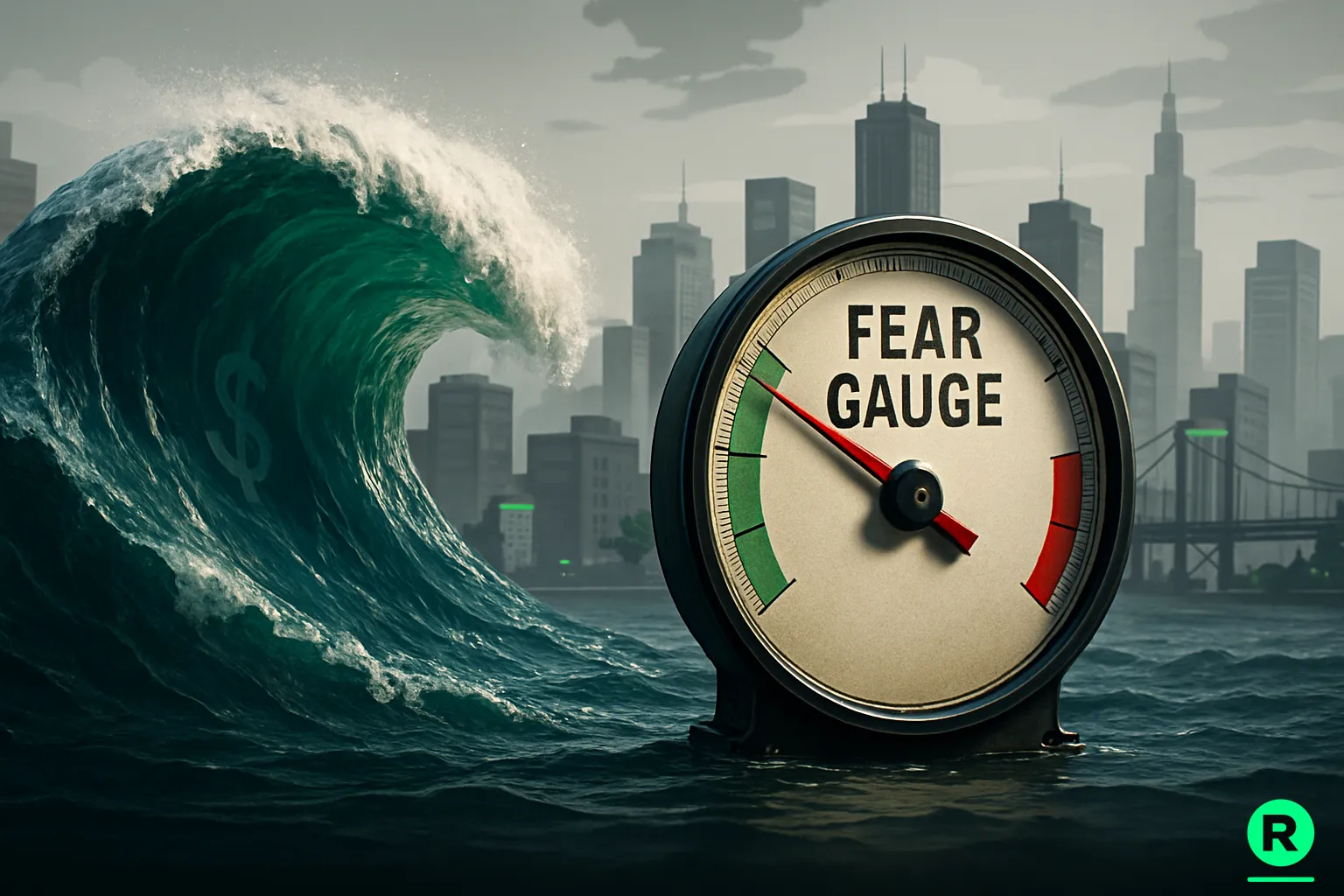
How traders use the Fear & Greed index
What goes into a Fear & Greed composite, why our build uses VIX (50%), S&P daily change (30%) and BTC (20%), and how to act on extreme readings without becoming a permabear or permabull.
Fear & Greed is a composite sentiment indicator. Below 25 (extreme fear) historically marks tactical buying opportunities; above 75 (extreme greed) marks tactical caution. It is a market mood ring, not a timing tool.
Fear & Greed indices are sentiment composites. They take a handful of liquid market signals, normalise each one to a 0-100 scale, weight them, and produce a single mood number. Done right, they are useful as a regime indicator. Done wrong, they are vibes-as-a-service.
The RockstarMarkets composite uses three live inputs. The VIXThe 30-day implied volatility of S&P 500 options. The 'fear gauge.' gets 50% of the weight because nothing aggregates fear faster than the price of insurance. The S&P 500 daily change gets 30% — strong up days drive greed, sharp down days drive fear. Bitcoin gets 20% — crypto is the highest-beta risk-on asset and it leads sentiment in the speculative tail.
How to use it: not as a signal in isolation, but as a frame. When the index is below 25, the market is in extreme fear. Historically, that has been a better-than-coin-flip moment to add to risk, but only if the underlying fundamentals have not changed. If the fear is driven by something genuinely new (a credit event, a war escalation), the cheap level can get cheaper. If the fear is mean-reverting noise (an earnings miss in one name, an isolated headline), the index gives you permission to do nothing while everyone else panics.
The opposite extreme — above 75 — is more dangerous because greed can persist longer than fear. The 1999 NASDAQ ran in extreme-greed mode for over a year before topping. Use 75+ readings to tighten stops, harvest some gains, and resist the temptation to add to winners on margin.
Read the live composite on the home page; the breakdown shows what each input is contributing right now.
People also ask
Is Fear & Greed a buy or sell signal?
Why does RockstarMarkets use a different formula from CNN?
How often does the index update?
More from Learn
- How to read a market narrative
A practical breakdown of what makes a market narrative useful, how to spot the dominant one early, and which signals tell you when a narrative is about to flip.
- How to interpret the VIX
What the VIX actually measures, how to read its level vs realised volatility, the regimes that matter, and why the slope of the VIX curve often tells you more than the spot number.
- What is an options chain and how to read one
The basic anatomy of an options chain, what each column means (bid, ask, mark, IV, OI, volume, delta), and how to spot the strikes where positioning is concentrated.
- How AI is changing market analysis
What language models can and cannot do for market analysis in 2026, the three workflows where they win today, and the failure modes you have to actively manage when integrating them.